
Core sections
Header, work experience or equivalent evidence, skills, and education create the evaluation backbone for many job resumes.
Explore every major resume section, learn which sections are required or optional, see what belongs in each one, and build a structure that fits your career stage and target job.
Quick answer
Most job resumes need a clear header/contact area and enough evidence to evaluate experience, skills, and education or qualifications. Summary, projects, certifications, languages, publications, volunteering, courses, and other sections are optional based on the role. The strongest resume uses the sections your evidence needs—not every section a template can display.
What matters most
Header, work experience or equivalent evidence, skills, and education create the evaluation backbone for many job resumes.
Projects, certifications, languages, publications, courses, volunteering, and achievements become valuable when they answer a real hiring question.
Students, senior professionals, researchers, and career changers should not be forced into the same section hierarchy.
Inside PortCV
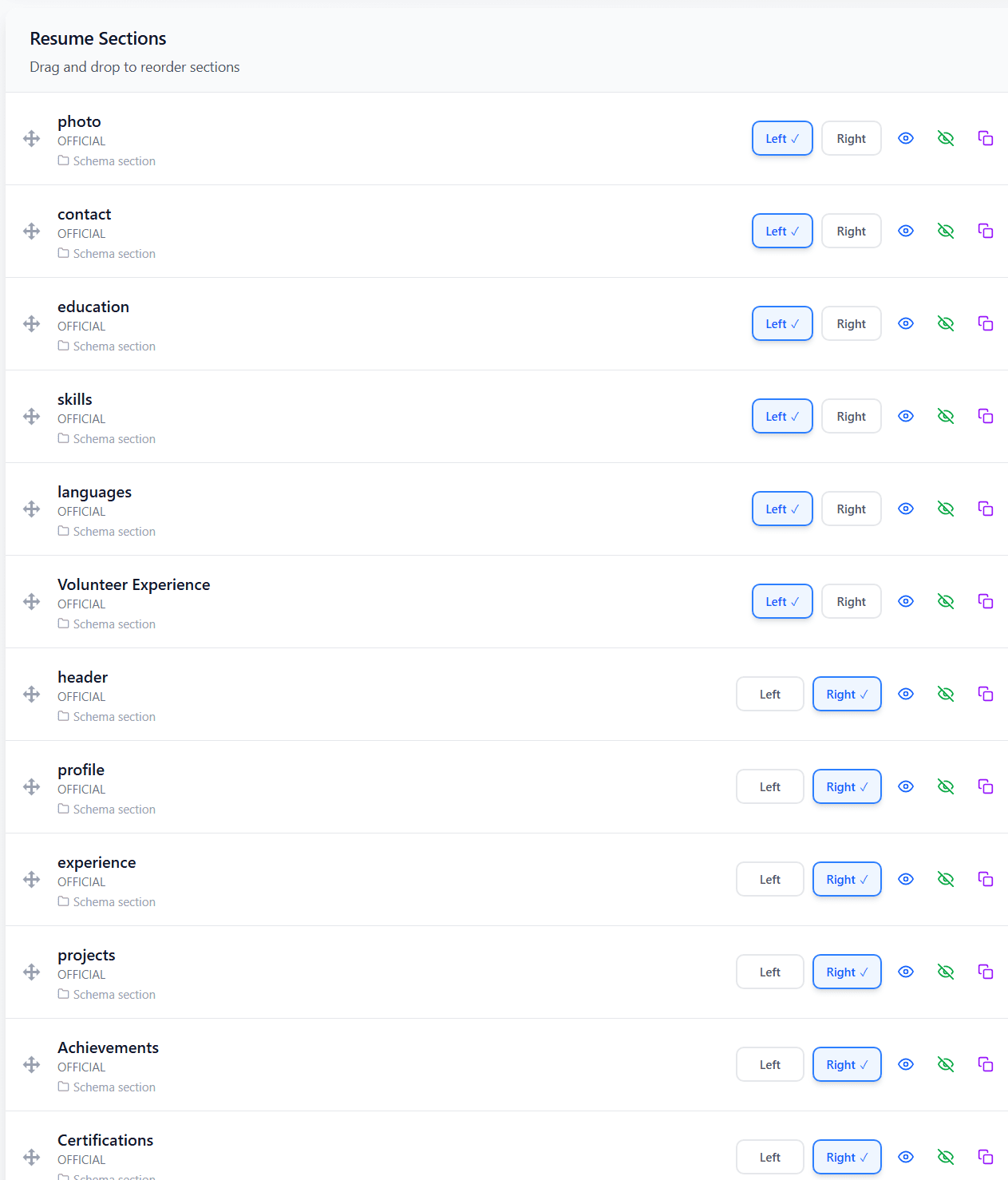
PortCV models the resume as structured semantic sections. Add the content your career needs, reorder it for the target application, show or hide optional evidence, edit nested items, use Copilot in context, and switch compatible templates without rewriting your career history.
Open the resume engineGuide 01
A recruiter should be able to identify you, understand the professional direction, see relevant experience or equivalent proof, locate important skills, and verify education or qualifications. Use familiar labels and keep top-of-page information compact.
A summary can help with positioning but is optional. The evidence underneath matters more than a generic opening paragraph.
Guide 02
Projects can prove applied skills, certifications formal qualifications, languages international capability, publications research output, volunteering leadership or community work, and courses recent upskilling. Optional sections become valuable when the target job gives them a reason to exist.
Do not keep hobbies, references, or training simply because a design has an empty block. Space should follow evidence quality.
Guide 03
Students may place education, projects, internships, and skills higher. Experienced professionals often lead with recent work. Researchers can prioritize education, research, publications, and conferences. Career changers may surface a focused profile, transferable projects, and relevant skills before older unrelated experience.
The PortCV engine can support these shifts without changing the factual source data.
Questions people ask
Most resumes need clear identity/contact details and sections that show relevant experience or evidence, skills, and education or qualifications. The exact core depends on the role and career stage.
Use as many as needed to organize relevant evidence clearly, but remove sections that contain only filler or duplicate information.
Yes. Order sections so the strongest job-relevant evidence appears early while the document remains easy to understand.
PortCV Resume Engine
Turn the guidance into a real resume in PortCV. Edit structured sections, refine wording with AI, check job alignment, switch layouts without rewriting your content, and export a polished PDF from one resume engine.